
Blog
What we shipped, and what comes next
Notes from the team that builds Verploy: what we finished, what we are working on now and what is coming. A few times a week.
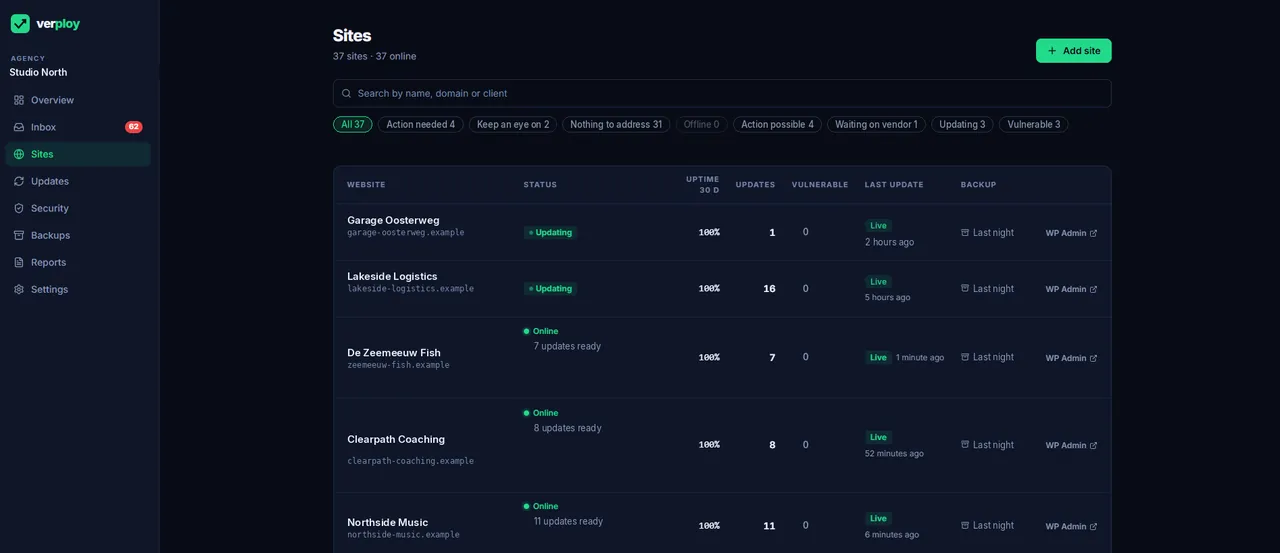
Day one: can Verploy work on this hosting? The connection check
Every hosting is a little different. Firewalls, security plugins, file permissions and disk quotas all decide whether a tool can do its work. You do not want to…
When an update only changes how a page looks: approve it with one click
Some updates are meant to change how a site looks. A new version of a theme or page builder can move a button, change a font or tidy up spacing, and that is not…
Broken links, missing images and spam links: found every night
A link to a page that was removed, a logo that no longer loads after a migration, a product link from an old campaign: clients notice these before agencies do.…
Client portal: give every client a private view of their site
Clients rarely log in to anything to check on their website, and they should not have to. But every now and then they want to know: is the site up to date, are…
What comes next: reliability first, then WordPress.org
Fridays on this blog are about what comes next. This week the answer is short: before we add more features, we want more of your updates to go live on their…
How we maintain our own clients’ WordPress sites with Verploy
Verploy did not start as a product. It started as a problem in our own agency. We build and maintain WordPress sites for our clients: shops, associations,…
Verploy is open to everyone: what we shipped this week, and what comes next
We build Verploy for our own agency first, and we ship small improvements almost every day. The changelog lists every version. This blog is the bigger picture:…
Every update checked, risky ones tested on a copy first: how Verploy decides
Agencies ask us one question more than any other: does every update really go to a test copy first? The honest answer is: not every update, and on purpose.…
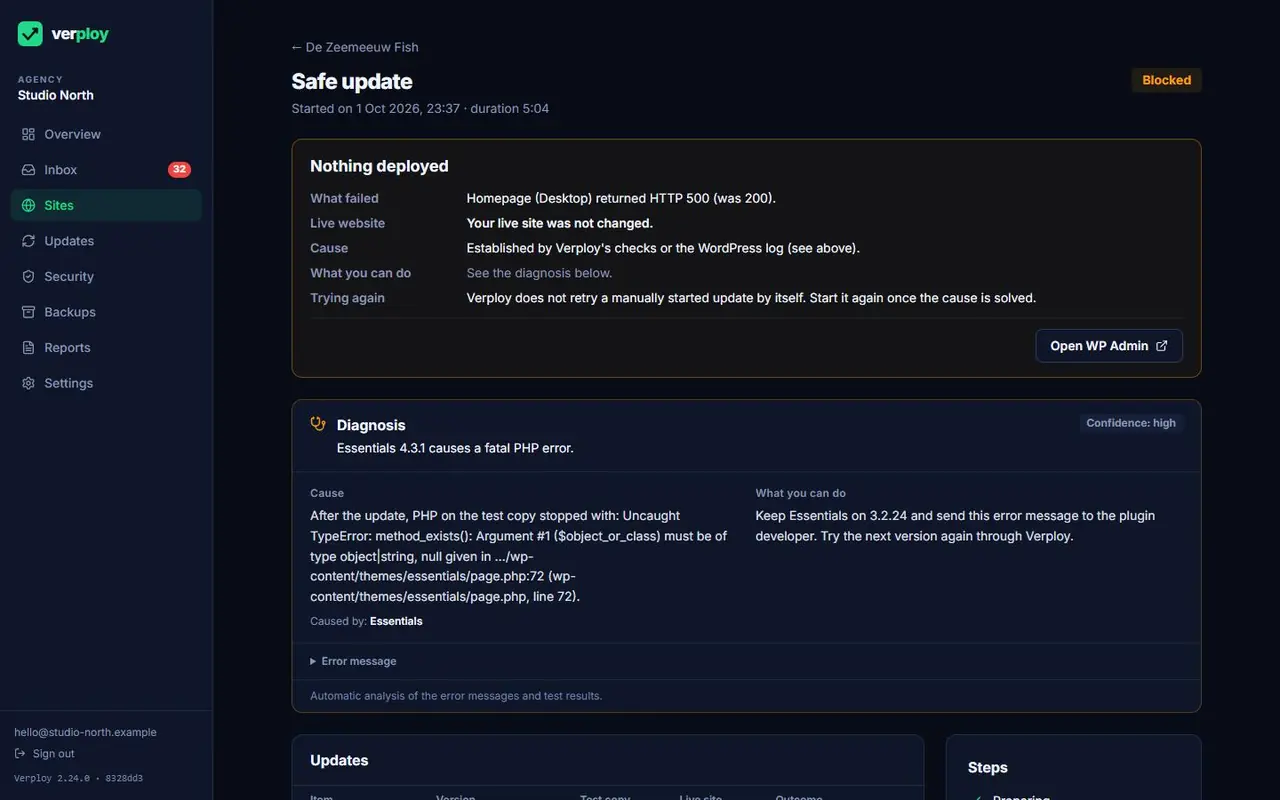
Held back or rolled back: what happens when an update goes wrong
Updates go wrong. A plugin conflicts with a theme, a page builder changes its layout, a licence is missing. What matters is what happens next. In Verploy there…
Our real numbers: 100 went live, 90 held back, 16 rolled back
We use Verploy on our own agency’s client sites every day. On the homepage we show the result of 30 days of real update runs, up to 2 October 2026:
Status page, changelog and alerts: how we keep you informed
If you trust a tool with your clients’ sites, you want to know when something changes, and you want to know it before your client does. These are the four…
Nightly backups you can restore, and prove you can
A backup you have never restored is a hope, not a backup. That is why Verploy does not stop at making backups.
Founding 30: start free on up to 3 sites, keep 40% off for life
Since 8 October, Verploy is open to everyone. No waitlist, no invitation, no credit card. Here is how pricing works, and what the first 30 agencies get.
Before and after: how Verploy compares your pages on desktop and mobile
A plugin update rarely breaks a site with an error message. Far more often, something just looks wrong: a menu that collapsed, a slider that no longer loads, a…
Forms and checkout, tested on the test copy before every risky update
A page can look perfect and still be broken. The contact form sends nothing, the quote form gives an error, the checkout does not open. For a client, that is…
Premium plugins and licences: how Verploy handles updates you pay for
Most agency sites run at least one premium plugin: a page builder, a forms plugin, a slider, a membership tool. They are often the plugins that matter most, and…
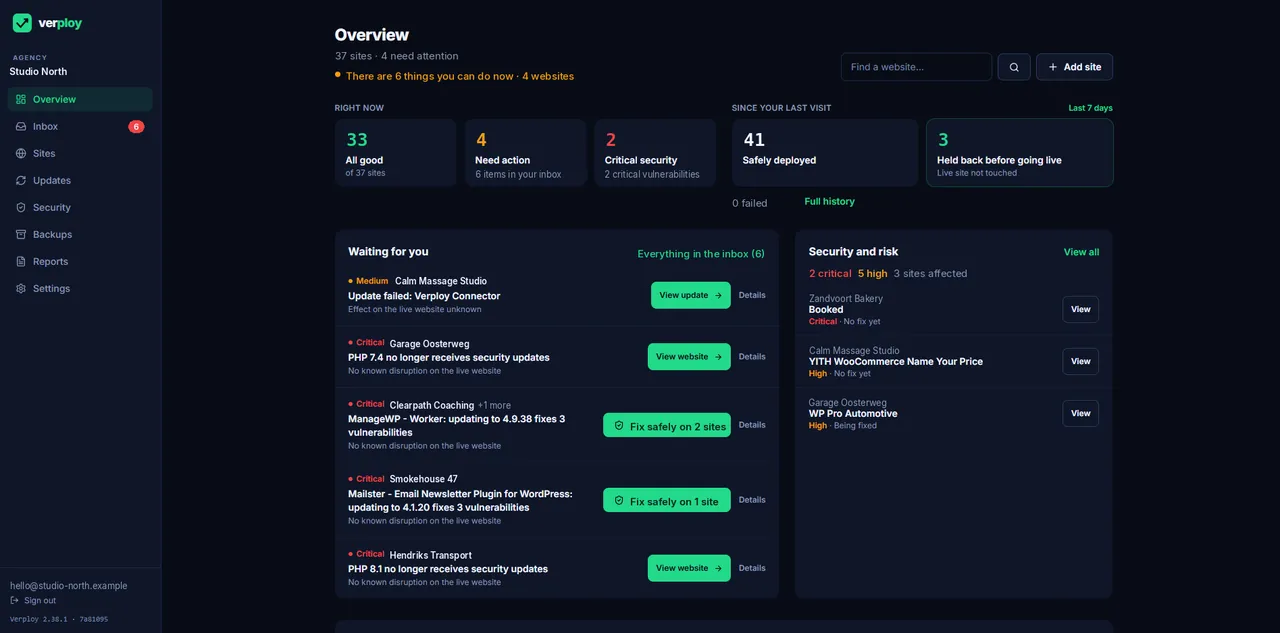
Vulnerabilities: ask first, or fix the serious ones automatically
Every week new vulnerabilities are published for WordPress plugins and themes. For an agency with dozens of sites, the hard part is not knowing that they exist.…
One plugin, all your sites: why Verploy updates in waves
A new version of a popular plugin comes out. You run it on thirty client sites. Updating all thirty at once is fast, until the new version turns out to conflict…
White-label client reports: show your clients what you did, in their language
Your clients pay you to look after their site. Most of that work is invisible: updates that went well, backups that ran, problems that never happened. A good…
Speed scores with Google PageSpeed, every day, for every site
A site that gets slower loses visitors and rankings, but it rarely happens overnight. A plugin here, a large image there, a new tracking script. Without…
Findability in Google: catch the one setting that hides a site
One checkbox in WordPress can make a whole site disappear from Google: "Discourage search engines from indexing this site". It is ticked during development, and…
Alerts in Slack or your own webhook, signed and only when it matters
Email works, until it gets buried. Many agencies run on Slack or their own tools, and want site problems where the team already works.
Know the risk before you click: risk per update, explained
Not every update is the same. A small fix release of a plugin that has updated cleanly for months is not the same as a major version of your page builder.…
The test copy: private, isolated and gone after the run
A test copy is only safe if it cannot do anything in the real world. A copy that sends order emails, fires webhooks or renews subscriptions is not a test; it is…
Health monitoring: SSL, domain, PHP and uptime in one view
Updates are only part of keeping a site healthy. An expired certificate, a domain that lapses or a PHP version without security support can take a site down…
The data guard: orders and form entries survive a rollback
Rolling back an update sounds simple: put the old version back. On a shop, it is not. Between the update and the rollback, customers may have placed orders. A…
The road so far: from first release to 2.41 in three weeks
Our new website went live on 24 September. Since then we have shipped more than thirty versions of Verploy. Here is the short version of what changed, so you…